Sunday, May 23, 2010

The Art of Eating In : a review


The Art of Eating In: How I learned to stop spending and love the stove by Cathy Erway (2010)


The author of the popular blog Not Eating Out in New York chronicles her 2-year experiment to eat only home-cooked food. In addition to cooking at home, she explores other eating alternatives like supper clubs, trash diving, and urban foraging. As you might expect, recipes are included. Because it’s about changes she made in her lifestyle, it also chronicles parts of her personal life – primarily romantic relationships and family – but those are minor sub-plots in the otherwise food-focused narrative.

As someone who has been consciously trying to cut down on eating out, I was intrigued by the subject and pleasantly surprised at how much I enjoyed reading it. Erway’s writing isn’t the best, with some awkward phrases and stilted dialogue, but her culinary adventures are inspiring. (I’m not kidding - the day I finished the book I spent close to 4 hours in my kitchen making samosas.)

At a little over 300 pages there is a lot packed into her book, but I still wanted more. First of all, I’m always curious about how people who cook a lot handle the day to day aspects of planning, shopping and fitting this all into their schedules (though Erway was pretty forward about cooking being her main hobby). Secondly, I wanted to know what sorts of things she cooked on evenings when she was in a rush and made something simple and quick before or after her evening plans. This is part of what I find so difficult about not eating out – coming up with something quickly when I’m hungry and standing in my pantry staring at a hodgepodge of random ingredients. But this isn’t a how-to manual, nor was it written with my particular culinary questions in mind so I’ll forgive her for not including much on these subjects.

I clearly don’t have the innate creativity and love of cooking that made Erway’s experiment so successful. But her point was taken – eating home cooked food is cheaper, healthier, in many cases tastier, and less trash-producing than a diet of fast-food, take-out and restaurant food. Though it would be extremely difficult for most people to even come close to what Cathy Erway did, most of us could certainly benefit from cooking more at home, and her book is an entertaining and inspiring starting point.

Tuesday, May 18, 2010

The Giant's House : a review


The Giant's House by Elizabeth McCracken (1996)


This is one of my very favorite books and I just read it for the second time after buying a used copy. This means I can dog-ear the pages to mark my favorite passages. There are approximately 20 dog-ears in it already which I suppose renders the practice moot, but nonetheless I find it immensely satisfying.

I wrote almost nothing about it last time and while I still can’t do it justice, I will at least tell you a little about the plot. The narrator is a librarian on Cape Cod who meets and falls in love with a remarkable young man. He is a giant, growing quickly and unstoppably, doomed to die before his time from the condition. Peggy befriends him at the library and eventually becomes a more personal friend, finally becoming romantically involved, but rather too late.

The story is beautiful and sad and I love both Peggy and James. The first time I read this book, I think it was all about James for me but this time I thought much more about Peggy and her life. She was socially rather inept, romantically challenged, and didn’t really like people. But, despite the vast difference in their ages, for some reason she loved James. Of course their relationship was doomed and Peggy seemed to accept this, as she accepted the many unhappy circumstances of her life.

If you haven’t read this book yet, I urge you to do so now. In closing, I’ll leave you with this brief love poem that James wrote for Peggy:

Love Poem for a Librarian

Although her love for me is infinitesimal,
Her eyes are as Dewey as any old decimal.

Sunday, May 16, 2010

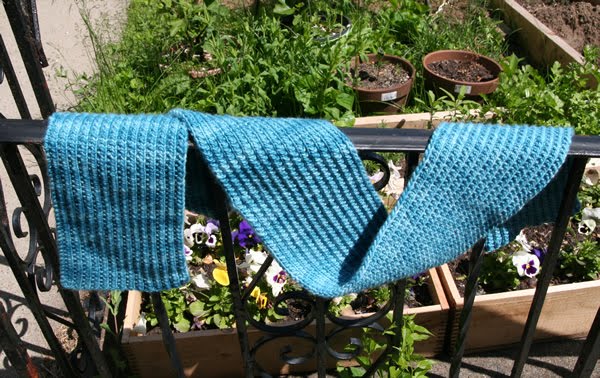
Scrunchable Scarf


This was a super simple pattern, found free here. I used Malabrigo Worsted in Bobby Blue and size 8 needles.

The scarf isn’t super long, but it’s thick enough that I wouldn’t have to wrap it multiple times anyway. Originally I planned to use a bulky yarn but the day I went shopping there wasn’t a color I liked in the bulky Malabrigo. I think it turned out quite lovely anyhow and seems to be warm enough. (Of course it’s almost June so it’s difficult to judge that accurately.)

I will need a matching hat because this color doesn’t go with any of my hats. I don’t want it too matchy-matchy, which is why I only bought enough yarn for a scarf, so I will look for a complimentary color. Maybe gray? If I have a little of the blue leftover perhaps I can use it for an edging on the hat.

Tomorrow I’m going to Windsor Button to find buttons for my Puff-Sleeved Cardigan, so I’ll look at potential hat yarns while I’m there. And of course this means I should have finished photos of my cardigan soon! Be patient though, because I have to block it and make sure it’s perfect before I reveal it to the world.

Wednesday, May 12, 2010

Emotional Intelligence : a review

This has been on my list to read for a long, long time! It was very interesting, but not quite what I expected. Goleman teaches us a bit about how the brain works, defines emotional intelligence, talks about its effects and why it is important, and shares stories about some schools using it in their curriculums.

What I was hoping for, and what it didn't deliver, was more of a how-to. In the section where he defines emotional intelligence, he talks a bit about things like managing one's feelings, feeling empathy, and that sort of thing, but he never actually provides any advice on developing one's emotional intelligence. The most useful part of the book was Emotional Intelligence Applied - real-world scenarios of his principles in action in marriage, business management, and health. He provides interesting information about how emotional intelligence is good for you, your relationships, and your work with examples and statistics. I got a little bored with all the child-related chapters near the end, but it's probably useful for parents.

Goleman has written several other books and hopefully I will eventually read some of those. A few of them are a bit to spiritually-focused for me, but I'm particularly interested in one called Social Intelligence, and also Working with Emotional Intelligence. I don't generally read self-help books and in fact get pretty bored with most non-fiction regardless of how much the subject matter interests me. Rather than reading the books, I'd love to just attend a workshop or lecture on these topics, but I suppose I will have to settle for reading.

4/23/2011 Updated to correct a book title

Monday, May 3, 2010

This World We Live In : a review

In the third and final installment in the trilogy by Susan Beth Pfeffer that began with Life As We Knew It, the characters from the first two books finally meet each other. Narrated again by Miranda from the first book, through the pages of her diary, we hear more about the family’s struggle to survive. Miranda’s older brothers leave for several days on a fishing trip and return with not only lots of fish, but a new “wife” for her older brother. The concern about the extra mouth to feed is soon overshadowed when their father also returns with his wife and their new baby, as well as a new friend Charlie, and Alex and Julie from book two. The family has now grown to 10 people and with the house so crowded, they eventually spread out into the neighbor’s house as well.

This book has little forward momentum, and almost none of what I was hoping for. The first two books got us used to the catastrophe and the new set of circumstances in which everyone is living; I hoped that this book would give us a feeling for what was to come – will humans be doomed, or will they begin rebuilding society? But unfortunately, I have no idea. Those questions weren’t answered, and the book doesn’t feel final at all, though the author says it’s the end of the series. It ended rather abruptly as well, with a weather-related catastrophe, and then it all wrapped up very quickly. It left me unsatisfied and disappointed.

Friday, April 30, 2010

The Little Stranger : a review

Dr. Faraday visited Hundreds Hall once as a child when his mother was a servant there, but doesn’t return until he is called there to treat a servant. He is intrigued by the Ayres family and soon begins to visit regularly, becoming involved with the troubled family. He is drawn to them all, but especially to Caroline. But something is happening at Hundreds, and though the family insists they are being haunted, Dr. Faraday explains it away as just symptoms of an old house and overactive imaginations. Despite his rational explanations, whatever it is continues to rip the family apart while he looks on helplessly.

I loved how subtle the story was. There was no ghost that you could see, and all of the incidents could be explained away, yet even Dr. Faraday had some doubts. Whether the house was haunted or whether the family was just haunted by psychological problems and their tragic past remains open to interpretation.

The characters were all complicated and troubled but in different ways. Mrs. Ayres was haunted by the child she lost so long ago, Roderick returned from the war both physically and psychologically damaged, and Caroline was a spinster who felt smothered by Hundreds Hall and wanted nothing more than to escape from it. Even Dr. Faraday had his issues; a confirmed bachelor, he was clumsy in his romantic pursuit of Caroline, and did not see what was obvious to the reader, that her feelings for him were lukewarm at best. I loved the feel of the book. There is something that appeals to me about watching a creepy old house – and the family within in – fall into ruins.

Tuesday, April 27, 2010

I may need more coffee for this

Last week I completed the first sleeve of my cardigan. The bound-off edge felt a little tight, but I thought I could just block it a bit. So I went ahead and seamed the sleeve, closed up the small hole in the armpit and weaved in the end of my yarn. "Finished!" I thought, and moved on to the next sleeve.

But I knew it was too tight. I tried it on, and it pulled at the sleeve of the shirt I was wearing under it. Maybe blocking would help, but you cannot hold out hope that blocking will solve all of your problems - believe me, I have tried it and been disappointed.

I just finished the second sleeve, using this fabulous stretchy bind-off. It is a miracle! A nice stretchy edge without flaring or otherwise looking odd. (I used this bind-off for my black v-neck sweater and the flaring was fine for that sweater, but not appropriate for this one!) But this new bind-off doesn't at all alter the look of the finished edge, making it just perfect for this sweater.

So. Now I must undo the bind-off for the first sleeve and redo it using this new miracle stretchy bind-off. Had I lazily left my weaving-in until the end it would have been much easier, but no - being Little Miss Knitting Overachiever, I try to weave in my ends as I go to make things easier on myself. Ha! Let this be a lesson to me. Now, you may be thinking that undoing the seam and woven in end is not a big deal, but it can be perilous indeed. For instance, there is that time I had to undo a seam and after undoing my woven in end and continuing along, I realized that I was actually unraveling the piece of knitted fabric.

Luckily, this time I managed to avoid that disaster, and now I have begun undoing my sleeve seam (my lovely, neat seam of which I was so proud!)

The danger has passed and it should be a piece of cake from here on out. I have undone many a standard bind-off so I do not anticipate trouble there. Sure, this has set me back a little, but extra time is well worth it to fix something that may make the difference between wearing the sweater and not wearing sweater. Had I not taken the time to make this better I would surely regret it later!