Showing posts with label sarah waters. Show all posts

Monday, May 2, 2016

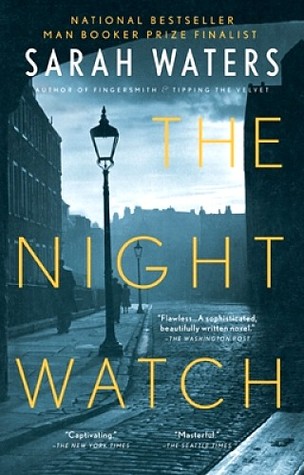
The Night Watch

The Night Watch by Sarah Waters (2006)

Opening a couple of years after World War II, this novel centers around several connected characters. Kay works for a Christian Scientist, who treats his patients by trying to convince them their maladies are all in their heads. Helen and Viv are coworkers in a match-making agency. Helen is in a relationship with an author named Julia, while Viv is in a relationship with a married man, and the two women don't know these things about each other. Also a secret is that Viv's brother Duncan was in prison. He now lives next door to Kay. The second part of the book takes place a few years earlier in 1944, and the third part goes back even further to 1941.

Waters has made some interesting choices with this timeline. For some story lines it means getting the emotional impact of an important reveal  at the end, while for others it ends with the initial meeting bewteen two characters who have no idea what they will go through together, but we do. It's almost ant-climactic in a couple of the cases, but that's ok because more than one big reveal at the end would definitely be overkill.

Before I started reading, for some reason I thought this was a less-liked Waters book and I wasn't expecting much. I have no idea why but I also thought it wasn't about lesbians. At any rate I was pleasantly surprised to find that I was wrong on both counts. In Goodreads ratings, it falls approximately in the middle, and there are definitely lesbians. I liked it not as much as Tipping the Velvet, but more than The Paying Guests or Affinity, maybe around the same-ish as The Little Stranger and Fingersmith. It's hard to say for sure since I read some of these so long ago.

My edition was around 525 pages but didn't feel that long at all! Every time I sat down to read I'd become engrossed and would be surprised at how many pages I had read when I checked. As with her other books, she makes the setting feel so real, and every little thing about the characters and their lives came alive so vividly. I felt like I wanted more from all of them - I wanted to know more about their pasts, more about what happened between the events of the different sections of the book, and more about what happens later. That's not to say that anything was left out that should have been included, just that Waters makes me so invested in her stories that I can't really get enough.

Long ago I swore off reading any other novels that take place during World War II so I feel a bit duped since I didn't realize that's when it took place. But I love Sarah Waters and had every intention of reading all her books no matter what, so the setting wouldn't have stopped me even if I had bothered to read anything about the book before I started it.

When all is said and I done, I feel quite satisfied that I have now read all of Sarah Waters's novels. On the other hand, I feel a more urgent need for her to write another one so I can read it because I want more books by Sarah Waters!

The Night Watch is the seventh completed book for my TBR Pile Challenge, which means I have only three left. I'm just as shocked as you are that I'm so far through this challenge so early in the year!

Monday, February 9, 2015

The Paying Guests

The Paying Guests by Sarah Waters (2014)

Four years after the end of the Great War, Frances lives with her mother in their house in London. Her brothers both died in the war, and her father soon after, so to make ends meet she and her mother have decided to take in lodgers. When Mr. and Mrs. Barber settle in, they at first are a bit of an inconvenience, but soon Frances becomes friends with Lilian and that friendship blossoms into a much more intense relationship. The situation is one bound to explode, and it does, changing their lives in ways they can't have imagined.

I heard very mixed reviews of this book, but I also know many Waters fans were disappointed in The Little Stranger, which I really liked, so I went into it with an open mind. I really enjoyed it for a while, and then this thing happened that rather ruined the whole story for me.

This is a little tough to write about because most of my thoughts have to do with events that happen later in the book and I don't want to spoil it, so I'll just be a bit vague. I've spent a lot of time thinking about why I don't like the parts that I don't like. I don't want to malign a book just because it didn't go the way I wanted it to (and this plot definitely didn't go where I wanted), because I don't think that's fair. Many times, in fiction and in life, things don't go the way we want. But I need to be convinced that it's possible, that it could actually happen that way, and I'm sorry to say that in this case I am not convinced.

Lilian does some things that I simply can't see her doing. I'm trying to be open - I realize that even in real life people sometimes do things that seem out of character - but I just can't buy it. Lilian is rather weak and wishy-washy and, as written, she would never do anything decisive in this situation. Her feelings for Frances aren't stronger than her feelings for her husband (which are lukewarm at best), and I don't see her disrupting her comfortable married life for a culturally-unacceptable relationship with Frances. So, I absolutely cannot buy the things she does in this story.

However, I did like Frances and found her to be a much more well-crafted character. She used to be politically involved, and she had a social life and a girlfriend, but when their relationship was found out it became somewhat of a scandal. Frances has shrunk into the role of caring for her mother and their house, and she came to spend her days devoted to her thorough cleaning schedule. There's a passage I quite liked early on, where she admits that she misses the War, and says "The big things don't count anymore. I mean the capital-letter notions that got so many of our generation killed. But that makes the small things count even more, doesn't it?" Now it seems like Frances might be ready for more, to get back to living her own life, and I want that for her. I get where she's coming from, and what she's struggling with, and how she has been affected by the loss she has experienced. It's too much that she's now drawn into this other horrible situation. I wish she had never gotten involved with Lilian. I wish Sarah Waters had written a different story for her.

When the big event happened more than halfway through the book, I wanted nothing to do with the situation that was created and I considered stopping right there. But I wanted to give Sarah Waters some credit and kept going right through the oddly abrupt ending. I feel like if your book is already 564 pages, and a rather slow build, it's awkward to suddenly rush the ending, but that's what happens.

Despite all my misgivings, I didn't dislike this novel. In fact, I mostly enjoyed reading it. The thing that happens is pretty far into the book and all was well up until that point. Even then, it wasn't awful (her writing is always beautiful), but it's still my least favorite of all Sarah Waters' books so far. (I still haven't read The Night Watch.) If you haven't read Sarah Waters, definitely don't start with this one, but die-hard fans should give it a try.

If you've read it, what did you think?

Tuesday, January 14, 2014

Affinity

Affinity by Sarah Waters (1999)

Margaret Prior has just begun charity work at Millbank prison as a "Lady Visitor." London's prisons in 1874 are pretty grim, and it is Margaret's job to spend time talking with the inmates in hopes of encouraging them towards being productive members of society upon their release. Margaret herself is recovering from a dark time in her own life and is therefore quite vulnerable to the charms of one of the inmates with whom she visits. Selina Dawes is a spiritualist, imprisoned for fraud and assault, and Margaret becomes quite attached to her, willing to take greater and greater risks in order to spend ever more time with her.

I love literature set in the Victorian period, and spiritualism was quite popular at the time. Like other spiritualists, Selina would hold seances, or "dark circles," and communicate with the deceased loved ones of her attendees. Margaret was quite drawn to Selina's stories and even began visiting a local spiritual society to learn more. As I tend to do with any book involving the supernatural, I wasted a bit too much mental energy trying to figure out whether or not I was supposed to buy into Selina's claims. It should have been enough to know that Margaret bought into it, as she is the first-person narrator of the story, but I'm too much of a skeptic for my own good. When all was said and done I liked the novel more after finishing it than I did while reading it.

Still, to me it wasn't as good as the other novels I read by Sarah Waters. This was her second book, and I don't think it quite lived up to her first one (Tipping the Velvet) or those that came later (Fingersmith and The Little Stranger.) It's hard to put my finger on why, but I don't think it's just the spiritualism theme. Somehow it's not as rich or descriptive and I didn't become caught up in it the way I was with her other books. This is not to say that I didn't like it, not at all. I think Sarah Waters is incredibly talented and her books that I've loved surpass most other books out there.

Even this one I quite enjoyed reading, especially everything about the prison conditions and the story that emerges about Margaret's past and her relationship with her sister-in-law. Waters sharply illustrates some of the ways women were confined at the time, both in prison and in general society. I'm looking forward to finally catching up completely with her work by reading The Night Watch, and am also quite excited to learn that her next novel, The Paying Guests, will be released in the fall. For those of you who have read Sarah Waters, how do you think Affinity compares to her other books? And what about The Night Watch?

Thursday, August 29, 2013

Fingersmith

Fingersmith by Sarah Waters (2002)

In a very Dickensian London, Susan Trinder has grown up among thieves. Her mother was hanged for a murderess and is raised by the kind Mrs. Sucksby who owns a baby farm. But Mrs. Sucksby and a man they call only Gentleman has cooked up a plot that will make them all rich. All Susan needs to do is pretend a ladies' maid to a girl called Maud Lilly and convince her to marry Gentleman so that he can then throw his wife into a madhouse and take her fortune. When Susan arrives and begins to feel affection for Maud she must remember her purpose and continue to play the role for which has been hired.

This is just the very beginning of the plot, but it's filled with various twists and turns and secrets. I was deliciously shocked a few different times along the way. I hear that this novel is an homage to Wilkie Collins's The Woman in White, which I still haven't gotten to but am sure I will like. For me, it was more like Oliver Twist, with the orphans and poverty and Fagin-like benefactors with illegal businesses. Nobody can be trusted, that's for sure.

As usual, Waters brought the setting alive with her rich detail and beautiful prose. Reading one of her books is to immerse yourself into another time and place, to really slip into another person's shoes and experience their life. I can't say that I especially liked any of the characters, but a few I could sympathize with. They were all victims of their upbringing or circumstances. All were intriguing though, and there were a few I wish I knew more about.

When it comes to Sarah Waters, I think I still liked Tipping the Velvet best so far, but Fingersmith was an excellent and well-told story which I enjoyed right up to its satisfying end.

Saturday, June 11, 2011

Tipping the Velvet : a review

Tipping the Velvet by Sarah Waters (1999)

From the oyster houses of Whitstable to the music halls of London, teenager Nancy Astley comes of age in Victorian England in Sarah Waters’ remarkable first novel. Nancy is perfectly content working in her family’s restaurant and spending her free time visiting nearby music halls, but when she sees a performance by male impersonator Kitty Butler, her life changes forever. Nancy immediately falls in love with Kitty, befriends her, and eventually moves away with her to help out in her act. Just friends at first, their relationship turns to romance, but Kitty folds under the pressure of living a secret life. After their dramatic break-up, Nancy journeys through the fascinating underbelly of London society as she dons a suit and works as a male prostitute, spends a year as a woman’s sex slave, and joins up with a brother and sister team of socialists.

Waters was an academic before she was a novelist, and it shows. Her attention to details of the period, such as the slang, make her story feel unusually real. Descriptions are lush and rich such as the wonderful parts about the restaurant and the process of preparing oysters, Nancy’s first impressions of the unsavory Dead Meat Market, and the lavish parties thrown at Diana’s mansion. I’ve never read a depiction of Victorian times that included this underworld of illicit sex, lesbianism, and male impersonation but considering the author’s background I suspect it’s based on reality.

Nancy was a very sympathetic character who goes through many changes throughout the book, and it’s hard not to feel her pain and loss. The most upsetting part, I think, was the disintegration of her relationship with her family. Nancy didn’t simply leave them behind without a second thought, but it was incredibly difficult to reconcile her family life with her new life. After being with Kitty for about a year, she goes back home to visit. But she had made the mistake of revealing her true relationship with Kitty in a letter to her sister Alice. Now Alice, who had long been Nancy’s best friend and confidante, wants nothing to do with her. She doesn’t tell the rest of her family what she has told Kitty, and she doesn’t go back to visit them again.

Every time a relationship ends, Nancy is left totally alone with nothing, and must start building a life almost from scratch. She reinvents herself over and over, as though trying to settle on her true self. It’s honestly rather exhausting and makes the book feel epic, even though it only spans 7 or 8 years. But it wasn’t tiresome at all – I loved every bit of it.

Before I started the book I planned to watch the movie afterwards, but there’s no reason to. Waters has created something so lush and complex I doubt it could be captured properly on two hours of film. I want my impressions to stay as they are and not be tainted. I will, however, plan to read more of her books! I’ve already enjoyed The Little Stranger, but she has several more to choose from as well.

Friday, April 30, 2010

The Little Stranger : a review

Dr. Faraday visited Hundreds Hall once as a child when his mother was a servant there, but doesn’t return until he is called there to treat a servant. He is intrigued by the Ayres family and soon begins to visit regularly, becoming involved with the troubled family. He is drawn to them all, but especially to Caroline. But something is happening at Hundreds, and though the family insists they are being haunted, Dr. Faraday explains it away as just symptoms of an old house and overactive imaginations. Despite his rational explanations, whatever it is continues to rip the family apart while he looks on helplessly.

I loved how subtle the story was. There was no ghost that you could see, and all of the incidents could be explained away, yet even Dr. Faraday had some doubts. Whether the house was haunted or whether the family was just haunted by psychological problems and their tragic past remains open to interpretation.

The characters were all complicated and troubled but in different ways. Mrs. Ayres was haunted by the child she lost so long ago, Roderick returned from the war both physically and psychologically damaged, and Caroline was a spinster who felt smothered by Hundreds Hall and wanted nothing more than to escape from it. Even Dr. Faraday had his issues; a confirmed bachelor, he was clumsy in his romantic pursuit of Caroline, and did not see what was obvious to the reader, that her feelings for him were lukewarm at best. I loved the feel of the book. There is something that appeals to me about watching a creepy old house – and the family within in – fall into ruins.