Wednesday, September 10, 2014

Sisters' Fate

Sisters' Fate (The Cahill Witch Chronicles #3) by Jessica Spotswood (2014)

Finally, the third and final volume of this series has arrived! When we left the Cahill sisters, the witches had just caused a mutiny at Harwood Asylum and rescued a large group of women who had been committed unjustly and horribly mistreated. But the witches were divided, and Maura was so angry at her sister Cate, she did the worst thing she could think of - she erased Finn's memory so he didn't remember her. I didn’t know how Jessica Spotswood was going to write us out of this horrible situation. Of course I shouldn’t have worried, and I wasn’t disappointed with the wrap-up of this series.

Now, not only are the witches still in danger, but a fever is sweeping New London and the Brotherhood is trying to keep it a secret. The witches want to prevent further spread of the disease without revealing themselves, but as Sister Inez gains more power the Sisterhood's internal rifts only increase.

Since the first book of the trilogy, we’ve known about the prophecy the Cahill sisters are meant to fulfill. One family of three witches, all with the ability to use mind magic: one sister will be an oracle, and one sister will kill another.  I wondered if that last part of the prophecy would come true at all, or whether fate would somehow be thwarted. Tensions increased between all three Cahill sisters as Tess's visions became more and more terrible and real, convincing her she was going mad, and Cate remained furious with Maura for erasing Finn's memory. The conclusion was both exhilarating and satisfying.

I love the world that Spotswood has created for this story. In this alternate New England, witches have been persecuted so heavily that all women are punished, and greatly oppressed by the powerful Brotherhood. The paranoia and secrecy remind me a bit of the Soviet Union or North Korea, though of course old New England has a very different feel from those places.

Although there is romance, the best relationships in the series are those between the sisters and among their friends. We learn a lot about their friends and their friends' families compared to other teen books, but it doesn't get too complicated. It was just enough to make their friends seem real and interesting, and I think it helps remind us that this is their story too, and not just that of the Cahill sisters. There is an awful lot at stake here.

Sisters' Fate is a strong finish to a series that deserves more attention than it has gotten. I realize there's a lot of competition, but not many trilogies are so consistently good from start to finish. But I do what I can as a good librarian and recommend the first volume, Born Wicked, at every opportunity. (Because librarianship is all about making people read the books you love most, right?)

I hate to place undue pressure of authors to keep producing - and I do think it's enough of an accomplishment to write three really good books (or even one) - but I do hope Jessica Spotswood has more in store for us.

Tuesday, September 9, 2014

The Clockwork Scarab

The Clockwork Scarab by Colleen Gleason (2013)

Mina Holmes and Evaline Stoker are mysteriously called to a meeting at the British Museum at midnight, where they are asked to investigate the deaths of two London society girls. The case, which takes them through the streets of an alternate London, involves steam technology, ancient Egyptian rituals, and time travel. The niece of Mina Holmes and the younger sister of Bram Stoker must channel all their strengths to thwart a dark figure's dangerous plans, and prove they're worthy of their family's reputations.

This is the first steampunk fiction I've ever read, and I really liked those aspects of the story. If you're not familiar with steampunk, it is basically the way that people in the 19th century would view the future. So there are a lot of high-tech machines but they are mechanized rather than digital, and there are flying machines but they are airships rather than airplanes. There's a particular style to it all too (a Google image search on steampunk would give you an idea). The author Holly Black once described it quite aptly, saying "Steampunk is what happens when goths discover brown."

In the world of Stoker and Holmes, electricity has been outlawed, and everything runs on steam. Buildings are so tall they sway, and sky-anchors float above them to keep them stable. London is built up vertically in addition to horizontally, with several levels of walkways. The best businesses are on the upper levels, and pedestrians must pay to rise up to those levels. Some of the clothing sounded extremely stylish as well - at one point Mina Holmes was wearing a dress in alternating panels of brown and rust, all embellished with pocket watches and clockwork gears. I found it all utterly fascinating and would love a movie version just for these visuals.

Unfortunately, the story didn't quite live up to the world it inhabits. I liked it, it was good, but it didn't knock my socks off. At the very beginning a visitor arrives from the future accidentally, which could have been quite interesting, but he was almost completely superfluous. There were a couple of other characters, too, who weren't brought into the story as much as I expected. But this begins a series and I wonder if there are more plans for these characters. If so, I think they may have arrived prematurely.

Nonetheless, I found much to like and I'm curious to hear what people think of the follow-ups. It's a great premise, and I found the characters of Mina Holmes and Evaline Stoker to be quite promising. They are smart and strong, and lock horns enough that working together as a team could be both thrilling and exasperating. I'm not sure whether I'll try the next one in the series, but it may well be worth checking out.

Sunday, September 7, 2014

Sunday Knitting

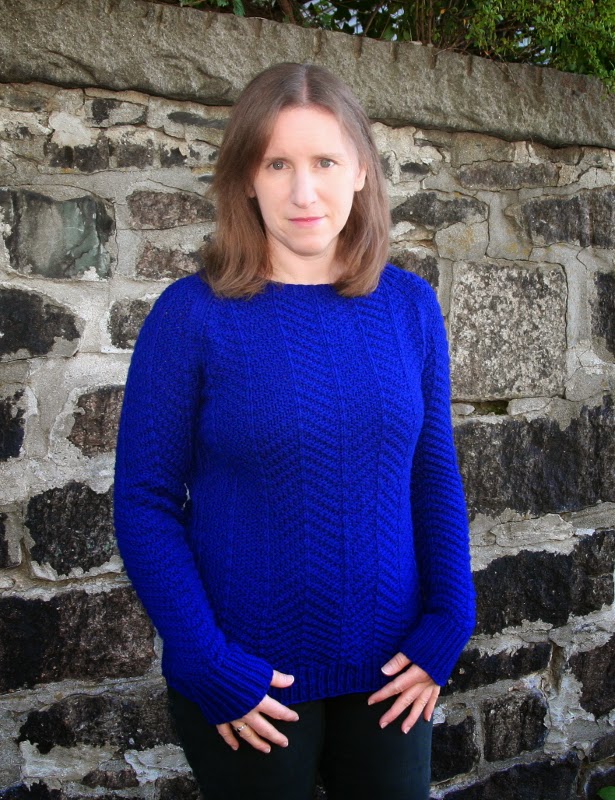
When last I posted, the sweater I had been working on for so long had turned into a butt-enormifying sweater mini-dress. But I ripped back and re-knit the hem, at which point it was...too fucking short. Seriously. I was so mad I didn't even take pictures, but just ripped it out again. And then knit some more.

The third time's the charm apparently, because now, much like baby bear's bowl of porridge, it is just right.


I'm not in love with it, but it's cozy and warm and that is pretty much what I was going for. It's more form-fitting that I would have liked, but I bet it will stretch a little. I'm glad I made the sleeves nice and long, because I always love those extra inches of warmth in the winter.

I was beginning to think that dark blue yarn is just cursed. Because there was this also, (the pics aren't showing up currently, but the whole, sad story is still available) which is still shoved in a bag in the back of a closet, probably half-eaten by bugs despite being acrylic. On the other hand, there's this hoodie vest which, despite the impractical combination of short sleeves and bulky yarn, I like quite a lot. So my research is inconclusive.

The thing is, I'm not even crazy about dark blue, so why I keep buying that color is a mystery even to me. I need to stop this madness. Luckily, this one appears much brighter in natural light, which is a bonus.

For this sweater, it was the textured pattern I like, but I confess it doesn't look a lot like the picture in the magazine. The fit is also different. It fits me, but snugly, and I was going for something loose, though I can't complain since I didn't swatch.

In the end, the project is a success and I've been very happy to cast on for some new things which I'll be sharing soon!

Friday, September 5, 2014

Say What You Will

Say What You Will by Cammie McGovern (2014), narrated by Rebecca Lowman

As if high school wasn't difficult enough, Amy has cerebral palsy and needs help getting between classes so she always has an aide with her. For senior year, she decides to hire other students as aides rather than adults in an attempt to possibly, finally, make some friends. One of her aides is Matthew, whose constant counting and hand-washing have made socializing a bit challenging for him as well. Amy and Matthew understand each other and become friends right away, though slowly they both realize that their feelings are something more.

What I love the most about this story is the message about how many kinds of disabilities there are - and how many of us don't fit into the mold one way or another - but how it's just more visible with some people than others. Amy couldn't get around very well, or talk without using a device, but she was super smart and determined and fearless. Matthew was outwardly perfectly fine, but paralyzed by obsessive-compulsive disorder. They were both misunderstood by others but totally got each other in a fundamental way. Best of all, they both challenged and helped each other in the most important parts of their lives.

Being described as The Fault in Our Stars meets Eleanor & Park is a pretty tall expectation to live up to, but the comparison makes a lot of sense and I think fans of those other books will love this one too. Personally, I didn't love it quite as much, but it was still one of the best teen novels I've read in a while. As with those two other books, the strength is in the characters, self-aware but still flawed, and the way their relationship builds throughout the novel.

I found myself quite attached to both of these characters. It's hard not to feel for Amy, with the physical challenges of her life and how they have affected her socially, not to mention her well-intentioned but overbearing mother (who was a pretty interesting character herself.) And Matthew, who was so clearly holding himself back from so much in life, and just needed Amy to help him see it. It wasn't all smooth sailing, of course - they are teenagers, after all, and prone to miscalculations and hurt feelings. But McGovern handled those situations brilliantly.

There comes a point in many in teen books in which there is a great misunderstanding. Someone sees or hears something, makes assumptions, and it causes a rift that blows everything out of proportion and doesn't get resolved until the end, at which point I'm thinking, in exasperation, "Had you just asked the person what happened instead of assuming, none of this would have happened." I realize that occasionally these situations may occur in real life, but I for one don't have the restraint to not ask, for instance, "What what you doing with that girl last night?" or "Why didn't you call me?" It is like characters just don't want an explanation, and think nothing of ending an important friendship over something they haven't bothered to understand. But here, when a great misunderstanding occurred, the characters actually confronted each other with these questions, and it all goes to show that the plot can move forward without the characters in ways that are so obviously contrived. This alone elevated this book in my esteem.

The audiobook is narrated by Rebecca Lowman, who I wish I could pay to move into my house and read to me all the time. Sometimes I forget that there are actually other narrators who I've enjoyed. It's a problem. She did a great job here, of course. The chapters alternate between characters and one of Lowman's strength is how well she does male voices.

Whether you read or listen, Say What You Will is a must for anyone who enjoys teen fiction.

Tuesday, September 2, 2014

The Orphan Master's Son

The Orphan Master's Son by Adam Johnson (2012)

After his mother was kidnapped and taken to Pyongyang, Pak Jun Do grew up in an orphanage called Long Tomorrows. In turn he became a tunnel soldier, a kidnapper, a transcriber aboard a fishing vessel, and another person entirely. In Adam Johnson's version of North Korea, Jun Do has almost no control over his life, but must constantly adapt to changes thrown his way in an effort to survive, until he eventually finds a way to take matters into his own hands. And all the while, the loudspeakers address citizens with news from around the nation, and world news from countries they consider oppressive, like South Korea, Japan, and the United States. Also broadcast is a reading of the year's Best North Korea Story, a story about the actress Sun Moon and her husband Commander Ga, which may not be fiction at all, but the story of Jun Do's reality.

In a country built upon propaganda and lies it's hard to know what to believe, and the same goes for this story. It is both bleak and absurd, a combination that reminds me of many Russian novels I've read. Also similar is the fear and paranoia that everyone lives with. An unnamed narrator who works as an interrogator lives with his elderly parents, who even in their own home speak only in stock government-approved phrases. Such is the fear of prison and death which permeates the lives of everyone in the book. Even those who work high up in the government aren't immune. Anybody's life could change in an instant, with no warning and no explanation.

Jun Do maintains that he was not an orphan like the other kids at Long Tomorrows. He thinks his mother is still alive out there somewhere and says that the Orphan Master, the man who ran the orphanage, is actually his father. Throughout the book I doubted whether this was true, but he didn't ever revisit the issue - I don't think he ever even thought about the man who was supposed to be his father, though he wondered about his mother's fate now and then. One of Johnson's major themes is the way that lives change and people just need to keep going in their new story without looking back. The apparent ease with which everyone accepted their separations from one another was a bit heartbreaking.

The North Koreans view their country as democratic and consider themselves very well off compared to other nations. When a group of Texans came to visit, the Koreans planned to give them food aid, as so many Americans are starving. The statistic they quoted, by the way - that 1 of 6 Americans goes hungry every day - is accurate, which just goes to show you how thin the line between propaganda and the truth. Meanwhile, of course, North Korean citizens were keeping themselves fed with bark from trees, and other things I just don't want to even think about. I'm a little upset at Adam Johnson for even putting some of these images in my head.

There's actually a lot of graphic imagery throughout the story. In addition to the aforementioned desperate measures of starving people, we get a pretty close-up look at North Korean methods of interrogation. These scenes aren't especially frequent, but they're pretty horrifying, so if that sort of thing upsets you, you may want to steer clear. But I suppose anyone who only wants to read about pleasant things isn't going to pick up a book about North Korea.

I was intrigued by The Orphan Master's Son since I first read reviews upon its publication. Little is written about North Korea, and I wondered how this American author did his research. It turns out that he spent some time in North Korea as part of his extensive research, a trip I'd really like to hear more about. The only other book I've ever read that was about North Korea was Escape From Camp 14 which only made me want to learn more about this mysterious country. The two books were remarkably similar in the blurring of lines between fact and fiction, despite one of them being fiction and the other non-fiction.

When The Orphan Master's Son won the Pulitzer, I actually became a bit wary of it, fearing that it might be dense and unreadable as many literary novels are. But I was pleasantly surprised. Not only has Johnson taken us inside a fascinating world - and one you only want to visit for a brief time - but he's populated it with people you really want to take with you when you leave. I wanted nothing more than to get Jun Do out of there. I wished it wasn't so long, but it was gripping enough to hold my attention throughout, and in the end it was absolutely worth it.

Tuesday, August 26, 2014

I Know Why the Caged Bird Sings

I Know Why the Caged Bird Sings by Maya Angelou (1970)

It's probably been close to twenty years since I first read Maya Angelou's memoir about growing up in the South in the 1930s, so I was happy to revisit her story. I imagine a lot of people have read this book recently since Angelou's death a few months ago, and it inspired a couple of people to recommend it for my library's next community read, which is why I've just read it now.

As a child, Angelou's parents divorced and sent her, along with her brother, off to live with their grandmother in Stamps, Arkansas. The kids move around a few times during their childhoods, to St. Louis, back to Stamps, and to California. Angelou recounts what it was like to be a young black girl in that time period, and how she grew to be a confident young woman in spite of it.

It was the Depression, but when you're poor and marginalized already, it's barely noticeable. The most traumatic incident of her childhood was being sexually assaulted by an adult she trusted. But, I think even more oppressive were the million tiny little ways she was slighted because of her skin color. The incident that stands out to me the most was the time that she had a couple of cavities that got pretty out of control and she was in a tremendous amount of pain. The local dentist only treated white people, but Maya's grandmother went to him anyway, claiming he owed her a favor. Still, they were turned away. By now Maya had been in pain for days, but it had to be prolonged even more while they boarded a Greyhound for a trip to a dentist who would treat her. And they just did it. They didn't raise a ruckus or anything because it wouldn't have gotten them anywhere, and honestly, who has the energy to fight back at every single indignity when they come so frequently?

Maya Angelou's experiences are not something I will ever understand fully. As a white American, how could I? But I can definitely tell you that I would not want to be treated the way she and her family and friends were treated. Which of course is why it's so important to read about experiences different from our own. There are so many little discriminations that take place every day and may not be obvious to someone not experiencing it (and I think most women can understand this to a certain limited extent) so reading this was a great reminder.

Of course it took place many decades ago, but as current events prove, we still have far to go as a society to achieve equality for everyone. If you're interested in the experience of African-Americans in U.S. history, or just want a good coming-of-age story, you won't go wrong with this classic.

Sunday, August 24, 2014

Sunday Knitting

And this, ladies and gentlemen, is why we swatch.

What the hell is this? Is it a sweater dress?
It is not supposed to be a sweater dress.

I think I mentioned that I didn't swatch for this, but despite my poor planning it was going fine. Honestly. It actually fit pretty well when I finished it and tried it on.

Then I washed it and blocked it. Which is why we not only make a gauge swatch, but we also wash it and block it. So we know how the finished garment may change when it, too, is washed and blocked. So there are no unfortunate surprises.

Never have I ever had a sweater grow lengthwise. They always, if anything, get wider and shorter. Oh, if only I could add some of this length to some of my too-short sweaters.

Because this, this is not flattering.

Hello, here is my enormous butt!

LESSON LEARNED.

But do you want to hear the good news? This sweater was knit from the top down, which means I can actually undo it from the bottom and rip out several inches of butt-enhancing fabric and get this craziness under control. It's a little more work, sure, but it's not the catastrophe it could have been.

Wish me luck.