Showing posts with label historical novels. Show all posts
Tuesday, September 13, 2016
Top Ten Favorite Historical Novels
Top Ten Tuesdays are hosted at The Broke and the Bookish. Today's topic is Top Ten Books of a genre of our choosing. There aren't many genres in which I read enough to be able to pick 10 favorites, but I do read a lot of historical fiction. It was hard to narrow down to 10, and I'm afraid that I'm forgetting something important, but here goes:
1. Tipping the Velvet by Sarah Waters
This story about a young lesbian in Victorian England is just dripping with historical detail and lush language. I know everybody's favorite Sarah Waters book is supposed to be Fingersmith, and I liked Fingersmith a lot, but I remember really really loving this one. I want to read it again sometime.
2. My Notorious Life by Kate Manning
Also Victorian-era (which is my favorite!) I loved this story of a woman who reinvents herself and becomes a midwife who provides birth control and abortions. Definitively feminist slant and wonderful historical detail.
3. Pillars of the Earth by Ken Follett
I was skeptical about reading a lengthy novel about the building of a cathedral, but it is SO MUCH more than that. I was completely engrossed in the lives of the many characters in this sweeping novel set in the 1100s.
4. Half of a Yellow Sun by Chimamanda Ngozi Adichie
This may be the only historical novel I've read set in the 1960s, but Adichie brought that period in Nigeria vividly to life. Everything she's written is fantastic, but this one was my first and the only one I'd consider historical.
5. The Miniaturist by Jessie Burton
Seventeenth-century Amsterdam is fascinating, and I was SO excited to read this novel about a young woman being married off to an older stranger who gives her a miniature replica of their house to decorate as a hobby. Many intriguing mysteries and secrets are woven among the period details to make this novel difficult to put down.
6. The Tea Rose by Jennifer Donnelly
Speaking of books that are hard to put down, this one (and the two sequels) got passed all around my family for a while several years ago. Set in Victorian London, the protagonist is an independent, headstrong woman (my favorite kind!) and I loved everything about the story and characters.
7. Moloka'i by Alan Brennert
This epic begins in the late 1800s when a 7-year-old girl is taken from her family to live in a leper colony. The novel spans her whole life, which is not only fascinating, but longer and happier than you'd think.
8. The Piano Teacher by Janice Y.K. Lee
Set in Hong Kong, the story moves between two timelines; one in the 1940s and the other in the 1950s. It focuses on events surrounding the World War II occupation of Hong Kong by the Japanese, and the relationships between several British and Chinese people. Lee's writing is just beautiful, and I also highly recommend her recent contemporary novel, The Expatriates.
9. The Luxe by Anna Godbersen
This teen series set in Manhattan beginning in 1899 was a ton of fun! Full of scandal and intrigue, the chapters all begin with snippets from society pages or etiquette manuals, adding lots of period detail. Of course, what reeled me in in the first place were the gorgeous dresses on the covers!
10. City of Thieves by David Benioff
I'm a sucker for anything set in Russia. This life-or-death adventure story about two young men during the Siege of Leningrad captures just the sort of dark humor common in many Russian novels.
What's interesting about this list is that these aren't necessarily my 5-star reads. I usually rate my books on Goodreads soon after reading them, but often the ones I give the highest ratings to don't stick with me, or vice versa. But when I sat down to think about books to put on this list, these are the ones I thought of right away.
What are your favorite historical novels?
Labels:
books,
historical fiction,
historical novels,
top ten tuesday
Monday, February 8, 2016
Hild
Hild by Nicola Griffith (2013)
Seventh-century Britain: Hild is born into an uncertain world where many kings vie for power. One small mistake, one illness, or a death in childbirth can change everything. During Breguswith's pregnancy, she had predicted that Hild would be "the light of the world," and so taught her to make prophecies even as a child. When Hild was three her father was poisoned, leaving her mother Breguswith alone with her two daughters. With nowhere else to turn, they went to the court of King Edwin, Hild's uncle, and she was raised as his seer.
Hild was less a seer than a keen observer, thinker, and guesser. Though confident in her abilities, she always knew that if she let him down she could be killed. Late in the book she made an especially important prediction that was obviously just a guess, and I couldn't help but admire how she patiently and calmly waited to find out the truth.
Political machinations always confuse me and there was a great deal of that here. It was difficult to keep track of all the people and places and sometimes I was confused about where a name was even a person or a place, never mind how they were related to the story. It was stylistically challenging as well, the writing reminding me most of A Game of Kings and Wolf Hall (though I liked this much better than Wolf Hall.) There were a few times that I reread a paragraph, especially those filled with various names and places, and felt rather stumped about what it was actually saying and I couldn't help but feel that I'm not really smart enough to read this. But I applied the same method I did to War and Peace; I just kept going without worrying too much about understanding every little detail. This worked pretty well. I know if I went back and read the whole thing again it would probably make more sense, but I won't be doing that.
Included in the book are a map (useful), glossary (useful), pronunciation guide (somewhat useful), and family tree (also just somewhat useful.) More helpful would have been a list of all the characters and a descriptions of who the hell they are. I can't tell you how many times a name was mentioned as though I should know who they were and I swear I hadn't seen it before. There were SO many characters in this book, and many of the names were similar (frustratingly like Game of Thrones, except that in this case many of the characters were real, so it makes more sense.) I kind of wish I had listened to the audio while reading, just to get the correct pronunciation. The guide in the back helped in some cases, but not all.
Lest you get the false impression that I didn't like the book, let me share my favorite parts. Hild was a super intriguing character who had complicated relationships with others, especially her mother. Breguswith was also rather fascinating and probably would make a great protagonist herself. Female characters all have a gemaecce, which is a formal friendship or partnership. It's like you are paired with a friend who you are stuck with for life, but in a good way. Griffith apparently created this term, but I kind of wish it was a real thing.
Marriage at this time was economic and political, but these characters found romance and pleasure in many forms. In the pre-Christian era apparently nobody cared who you had sex with or what gender they were. (Can we please go back to that? Thank you.) This was another of my favorite aspects of the novel, the way in which these people took pleasure where they could get it. It didn't hurt anyone, and made their short dangerous lives more enjoyable.
I really liked the descriptions of all the details of day-to-day life. My favorite part of reading historical novels is getting a taste of what it was like to live in that time and place and this novel was dense with such detail.
I was reading this in late January and early February, and I particularly loved this February conversation between Hild and her friend/half-brother Cian:
"The weather's changing," she said.
"It will never change. It will be like this forever. We will grow old and die and be forgotten, and the foxes will gnaw at our bones."
He always got like that after spending too much time indoors.
Winter is the perfect time to read this novel.
The ending was so intriguing and man, I want to talk to someone about it. Decisions were made that confused me a bit (as usual, I didn't quite understand the political situation involved) but also it was just...an unusual situation in other ways.
So I spent almost two full weeks reading this, felt a huge sense of accomplishment when I finished, went to Goodreads to mark it finished, and saw that it's listed as Light of the World #1. Now I feel rather deflated because this book is only the beginning. The second book isn't even listed yet so it's likely that by the time it comes out I won't remember much about this one. I'm definitely curious about what happens next because the ending, while not a cliff-hanger by any means, really kind of made me want to continue with the story. I have questions.
Since this book was published a few years ago, I've been drawn to the gorgeous cover, and I'm pretty sure it is that more than the rave reviews that really convinced me to read such a lengthy book. But I do need to credit my librarian friend Rebecca for telling me how good this book is, and that it's very dense but worth it. When the mother of a toddler tells you that a long dense book is worth the time and effort, you listen. The contents definitely live up to the cover. It's so complicated and beautiful and there is so much to talk about - I could actually go on for quite a while about this novel.
Hild is part of my 2016 TBR Pile Challenge, but also counts for Winter Bingo as a friend's fave. I've marked this off below, and also put a checkmark on the free square to make it more visually complete. Bingo! I only have a few more weeks for Winter Bingo and I've got two more books I'm hoping to read that I think will qualify. Neither will result in another bingo, but at least a couple more spots might get checked off.
Seventh-century Britain: Hild is born into an uncertain world where many kings vie for power. One small mistake, one illness, or a death in childbirth can change everything. During Breguswith's pregnancy, she had predicted that Hild would be "the light of the world," and so taught her to make prophecies even as a child. When Hild was three her father was poisoned, leaving her mother Breguswith alone with her two daughters. With nowhere else to turn, they went to the court of King Edwin, Hild's uncle, and she was raised as his seer.
Hild was less a seer than a keen observer, thinker, and guesser. Though confident in her abilities, she always knew that if she let him down she could be killed. Late in the book she made an especially important prediction that was obviously just a guess, and I couldn't help but admire how she patiently and calmly waited to find out the truth.
Political machinations always confuse me and there was a great deal of that here. It was difficult to keep track of all the people and places and sometimes I was confused about where a name was even a person or a place, never mind how they were related to the story. It was stylistically challenging as well, the writing reminding me most of A Game of Kings and Wolf Hall (though I liked this much better than Wolf Hall.) There were a few times that I reread a paragraph, especially those filled with various names and places, and felt rather stumped about what it was actually saying and I couldn't help but feel that I'm not really smart enough to read this. But I applied the same method I did to War and Peace; I just kept going without worrying too much about understanding every little detail. This worked pretty well. I know if I went back and read the whole thing again it would probably make more sense, but I won't be doing that.
Included in the book are a map (useful), glossary (useful), pronunciation guide (somewhat useful), and family tree (also just somewhat useful.) More helpful would have been a list of all the characters and a descriptions of who the hell they are. I can't tell you how many times a name was mentioned as though I should know who they were and I swear I hadn't seen it before. There were SO many characters in this book, and many of the names were similar (frustratingly like Game of Thrones, except that in this case many of the characters were real, so it makes more sense.) I kind of wish I had listened to the audio while reading, just to get the correct pronunciation. The guide in the back helped in some cases, but not all.
Lest you get the false impression that I didn't like the book, let me share my favorite parts. Hild was a super intriguing character who had complicated relationships with others, especially her mother. Breguswith was also rather fascinating and probably would make a great protagonist herself. Female characters all have a gemaecce, which is a formal friendship or partnership. It's like you are paired with a friend who you are stuck with for life, but in a good way. Griffith apparently created this term, but I kind of wish it was a real thing.
Marriage at this time was economic and political, but these characters found romance and pleasure in many forms. In the pre-Christian era apparently nobody cared who you had sex with or what gender they were. (Can we please go back to that? Thank you.) This was another of my favorite aspects of the novel, the way in which these people took pleasure where they could get it. It didn't hurt anyone, and made their short dangerous lives more enjoyable.
I really liked the descriptions of all the details of day-to-day life. My favorite part of reading historical novels is getting a taste of what it was like to live in that time and place and this novel was dense with such detail.
I was reading this in late January and early February, and I particularly loved this February conversation between Hild and her friend/half-brother Cian:
"The weather's changing," she said.
"It will never change. It will be like this forever. We will grow old and die and be forgotten, and the foxes will gnaw at our bones."
He always got like that after spending too much time indoors.
Winter is the perfect time to read this novel.
The ending was so intriguing and man, I want to talk to someone about it. Decisions were made that confused me a bit (as usual, I didn't quite understand the political situation involved) but also it was just...an unusual situation in other ways.
So I spent almost two full weeks reading this, felt a huge sense of accomplishment when I finished, went to Goodreads to mark it finished, and saw that it's listed as Light of the World #1. Now I feel rather deflated because this book is only the beginning. The second book isn't even listed yet so it's likely that by the time it comes out I won't remember much about this one. I'm definitely curious about what happens next because the ending, while not a cliff-hanger by any means, really kind of made me want to continue with the story. I have questions.
Since this book was published a few years ago, I've been drawn to the gorgeous cover, and I'm pretty sure it is that more than the rave reviews that really convinced me to read such a lengthy book. But I do need to credit my librarian friend Rebecca for telling me how good this book is, and that it's very dense but worth it. When the mother of a toddler tells you that a long dense book is worth the time and effort, you listen. The contents definitely live up to the cover. It's so complicated and beautiful and there is so much to talk about - I could actually go on for quite a while about this novel.
Hild is part of my 2016 TBR Pile Challenge, but also counts for Winter Bingo as a friend's fave. I've marked this off below, and also put a checkmark on the free square to make it more visually complete. Bingo! I only have a few more weeks for Winter Bingo and I've got two more books I'm hoping to read that I think will qualify. Neither will result in another bingo, but at least a couple more spots might get checked off.
Tuesday, February 2, 2016
Top Ten Historical Settings I Love
Top Ten Tuesdays are hosted at The Broke and the Bookish. Today's list is of my top ten historical settings. I've provided examples, and some of them are actually fantasy but I included them because the historical settings were so prominent.
1. 19th Century Russia
See: War and Peace, The Gathering Storm (fantasy, but historical setting)
2. Victorian England
See: oh gosh, so much! Tipping the Velvet, My Notorious Life, A Great and Terrible Beauty by Libba Bray, The Luxe, Anne Perry's William Monk series which begins with The Face of a Stranger; the earliest one I blogged about was The Sins of the Wolf
3. Colonial America
See: The Cahill Witch Chronicles beginning with Born Wicked, which are admittedly fantasy set in an alternative reality, but the setting was great. There need to be more good books set in this era!
4. Ancient China
See: Gunpowder Alchemy, which as above is also fantasy, but I've love to read some more books set in Ancient China.
5. 1920s in America
See: The Great Gatsby, Twilight Sleep, The Other Typist
6. The plague years in Europe
See: Year of Wonders
7. Europe Middle Ages
See: Doomsday Book, Pillars of the Earth, and Hild, which I am currently reading
8. 17th century Amsterdam
See: The Miniaturist, the only book I know of in this setting, but it was a fascinating time and place that was really brought to life in this novel.
9. 1940s in America
See: Ten Cents a Dance, The Girl is Murder
10. 1980s in America
Gah, I can't quite accept this decade as historical, but it is. I love it because that's when I was a teenager and as much as I hated my entire adolescence I still love 80s pop culture.
See: Eleanor and Park, and I want to say Ready Player One but it doesn't actually take place in the 80s, it's just full of 80s pop culture references.
What are your favorite historical settings?
Labels:
books,
historical fiction,
historical novels,
top ten tuesday
Thursday, October 4, 2012
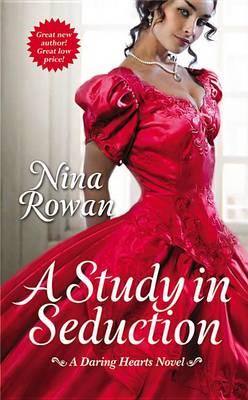
A Study in Seduction
A Study in Seduction by Nina Rowan (Daring Hearts #1)(2012)
Young mathematician Lydia Kellaway has lost many things - her parents, her virtue, and now her mother's locket, sold to a pawn shop and subsequently purchased by the handsome yet infuriating Lord Northwood. Lydia is determined to win the locket back, but at what cost?
Of course, a romance blossoms between Lydia and Alexander and it is fraught with obstacles. Alexander's family is still getting over the scandal of his mother running off with a Russian and his parents' resulting divorce. Lydia....well. She has dark secrets she cannot reveal to anyone, lest she cast scandal over her own family.
I first heard of this novel on the Smart Bitches Trashy Books website and its accompanying podcast Dear Bitches Smart Authors. The premise of the book sounded unusual, and I was further interested by the disagreement between the two podcast hosts about whether or not the book was any good.
Alas, I did not find this novel especially compelling, and there were some frustrating aspects. First of all, there is a huge reveal near the end and I saw it coming a mile away. I guessed from very early in the book, and I am not an observant reader who typically anticipates these things. I am oblivious, and am pretty much ALWAYS surprised when authors want me to be.
Furthermore, when Alexander discovers this shameful truth, he gets over it remarkably easily. Normally, I'd chalk it up to love but in this case the hero of the story has a pretty fresh scandal in his own family and those wounds are still a bit fresh. Would he be so quick to accept the possibility of another scandal? I find it hard to believe.
As for our heroine, she was likable enough until fairly late in the book at which point she began furthering the plot by continuing to insist on the likelihood of a scandal after that possibility had been eliminated. I hate when characters do this - they continue to keep secrets when it's no longer necessary or stubbornly cling to things that are untrue. So annoying! In this case, things were wrapped up pretty well and she just continued to draw out the drama in a way that was completely unnecessary. There is no reason for Lydia to continue in this vein except to draw the book out another couple of chapters.
The math aspect of story was a little lame. I realize it's a romance novel and not an academic treatise, but some of her demonstrations were just parlor tricks. But I thought she was fairly convincing as someone who enjoyed math immensely, and found comfort in its rules and structures (an aspect of the story about which the podcast ladies disagreed).
Altogether, it was neither wonderful nor terrible. I liked the premise, and mostly liked the primary characters (except for Lydia's stubbornness). I found the relationship between Alexander and Lydia compelling and as full of tension as it should be. Still, it was just ok. I probably won't make a point to read the next novel in the series.
Young mathematician Lydia Kellaway has lost many things - her parents, her virtue, and now her mother's locket, sold to a pawn shop and subsequently purchased by the handsome yet infuriating Lord Northwood. Lydia is determined to win the locket back, but at what cost?
Of course, a romance blossoms between Lydia and Alexander and it is fraught with obstacles. Alexander's family is still getting over the scandal of his mother running off with a Russian and his parents' resulting divorce. Lydia....well. She has dark secrets she cannot reveal to anyone, lest she cast scandal over her own family.
I first heard of this novel on the Smart Bitches Trashy Books website and its accompanying podcast Dear Bitches Smart Authors. The premise of the book sounded unusual, and I was further interested by the disagreement between the two podcast hosts about whether or not the book was any good.
Alas, I did not find this novel especially compelling, and there were some frustrating aspects. First of all, there is a huge reveal near the end and I saw it coming a mile away. I guessed from very early in the book, and I am not an observant reader who typically anticipates these things. I am oblivious, and am pretty much ALWAYS surprised when authors want me to be.
Furthermore, when Alexander discovers this shameful truth, he gets over it remarkably easily. Normally, I'd chalk it up to love but in this case the hero of the story has a pretty fresh scandal in his own family and those wounds are still a bit fresh. Would he be so quick to accept the possibility of another scandal? I find it hard to believe.
As for our heroine, she was likable enough until fairly late in the book at which point she began furthering the plot by continuing to insist on the likelihood of a scandal after that possibility had been eliminated. I hate when characters do this - they continue to keep secrets when it's no longer necessary or stubbornly cling to things that are untrue. So annoying! In this case, things were wrapped up pretty well and she just continued to draw out the drama in a way that was completely unnecessary. There is no reason for Lydia to continue in this vein except to draw the book out another couple of chapters.
The math aspect of story was a little lame. I realize it's a romance novel and not an academic treatise, but some of her demonstrations were just parlor tricks. But I thought she was fairly convincing as someone who enjoyed math immensely, and found comfort in its rules and structures (an aspect of the story about which the podcast ladies disagreed).
Altogether, it was neither wonderful nor terrible. I liked the premise, and mostly liked the primary characters (except for Lydia's stubbornness). I found the relationship between Alexander and Lydia compelling and as full of tension as it should be. Still, it was just ok. I probably won't make a point to read the next novel in the series.
Monday, March 29, 2010
Bound : a review
I hadn’t even heard of this book until the Cable Girl suggested it for book group, but it was right up my alley. A colonial girl grows up an indentured servant, but when her situation turns abusive she escapes. But her past catches up to her and she eventually ends up on trial for murder. Alice is the colonial equivalent of the high school student who won’t admit she’s pregnant until she ends up giving birth in a dumpster. She is naïve and makes some poor choices, but is still likeable. There were many times in the story that it didn’t go the way I thought it would, and many times I really wasn’t sure what she’d do. Perhaps it’s a poorly developed character that can’t be predicted, but it kept my interest and added to the pleasure of reading this book.
Just as with the Laura Ingalls Wilder series and all the other historical writing I’ve enjoyed, it’s the domestic details that I really love. In this novel, there is much spinning, weaving, knitting, gathering of flax, applying of poultices – so many wonderful details of life in that time period. In this case it was also tied in with political issues because there was a boycott on imported fabric. Knitting and weaving as political activism, how perfect!
Subscribe to:
Posts (Atom)